How to Become a Botox Injector
To become a Botox injector in the United States, you need an appropriate medical license first, then specialized training, then supervised clinical practice. In that order. Injecting botulinum toxin is a medical procedure, and no course or certificate replaces licensure.
This guide covers which licenses qualify, what the realistic sequence looks like, what "certification" actually means in aesthetics, and how to tell a serious program from a sales operation. If you are already licensed and looking for clinical training, Body Balance Medical runs a 3-day injector preceptorship in Las Vegas.
- Injecting neurotoxins and dermal fillers is a medical act. You need a qualifying license, registered nurse, nurse practitioner, physician assistant, physician, or dentist, before any training matters.
- Estheticians, cosmetologists, medical assistants, and unlicensed individuals generally cannot legally perform cosmetic injections, regardless of what courses they complete.
- The realistic path is sequential: license, foundational training, supervised hands-on experience, then gradual expansion of practice within your scope.
- "Certification" in aesthetic medicine means course completion. It does not replace licensure, board certification, malpractice requirements, or employer protocols.
- Requirements, supervision rules, and permitted procedures differ by state. Your licensing board's position governs, not a training provider's marketing.
What it really takes to become a Botox injector
Botox administration is a medical procedure. Specialized aesthetic training is necessary for licensed professionals who want to inject, but that training comes after licensure, never instead of it. A training program builds skill. It does not create legal authority to practice.
A Botox injector is a licensed clinician who performs neuromodulator injections and filler treatments as part of medical aesthetics, working with products like Botox, Dysport, Xeomin, and Letybo alongside common dermal fillers.
The general sequence is the same everywhere: obtain a qualifying clinical license, complete proper training in neurotoxins and fillers, gain supervised hands-on practice, then work independently or under a medical director according to the rules that apply to you. What differs is the detail. Requirements, supervision levels, and scope of practice vary by state and by role, so confirm your specific obligations with your state licensing board and your malpractice carrier rather than relying on general promises from any training provider.
Who can, and cannot, legally perform Botox injections
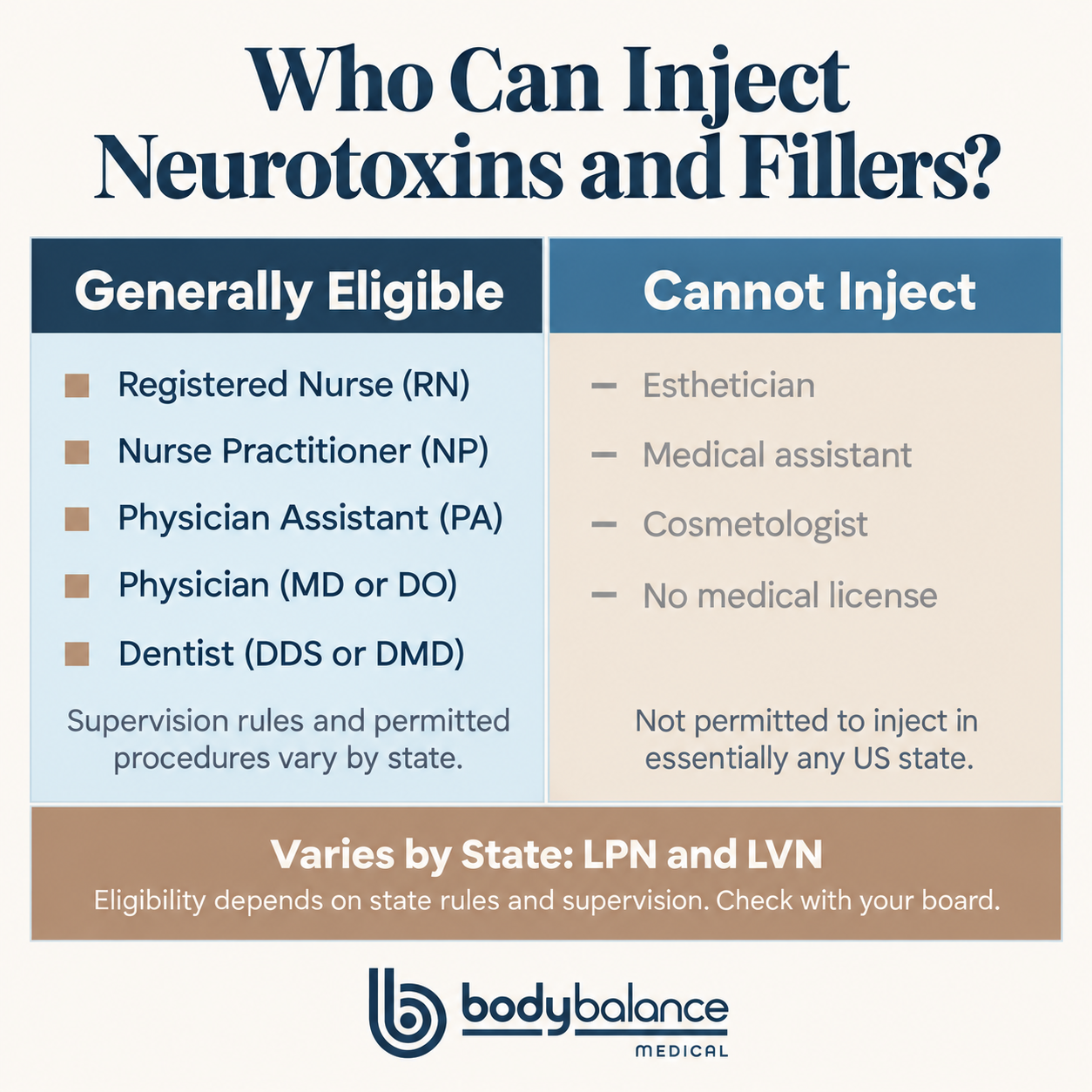
In most of the United States, only certain licensed medical professionals may perform Botox injections and administer dermal fillers. These rules exist to protect patients, not to protect professional turf. Injecting is a medical act, so it requires a qualifying clinical license. Which licenses qualify, and under what supervision, differs by state and by role.
Licenses that generally qualify
- Physicians (MD, DO) and dentists (DDS, DMD)
- Nurse practitioners and physician assistants, often under supervisory or collaborative agreements
- Registered nurses, typically with physician or advanced practice oversight
- LPNs and LVNs in some states, depending on board rules and supervision requirements. If you hold an LPN or LVN license, check with your nursing board and any prospective employer before enrolling in training
Who does not qualify
Estheticians, cosmetologists, medical assistants, and unlicensed individuals generally cannot legally perform Botox injections in essentially any US jurisdiction. Even when a course is willing to accept your tuition, it cannot grant you the legal scope to inject. This is the single most common and most expensive misunderstanding in aesthetic training.
- Your legal scope, confirmed directly with your state licensing board
- Whether your malpractice carrier covers neurotoxin and filler work, and on what terms
- Any medical director relationship or employer protocol you would be working under
Professional liability coverage matters because it protects you if a patient has a complication or an unexpected reaction. Coverage requirements and carrier expectations differ by state, so confirm yours rather than relying on what a program tells you.
Your step-by-step path into aesthetic injecting
This is the realistic, chronological route for nurses, NPs, PAs, physicians, and dentists moving into aesthetic medicine.
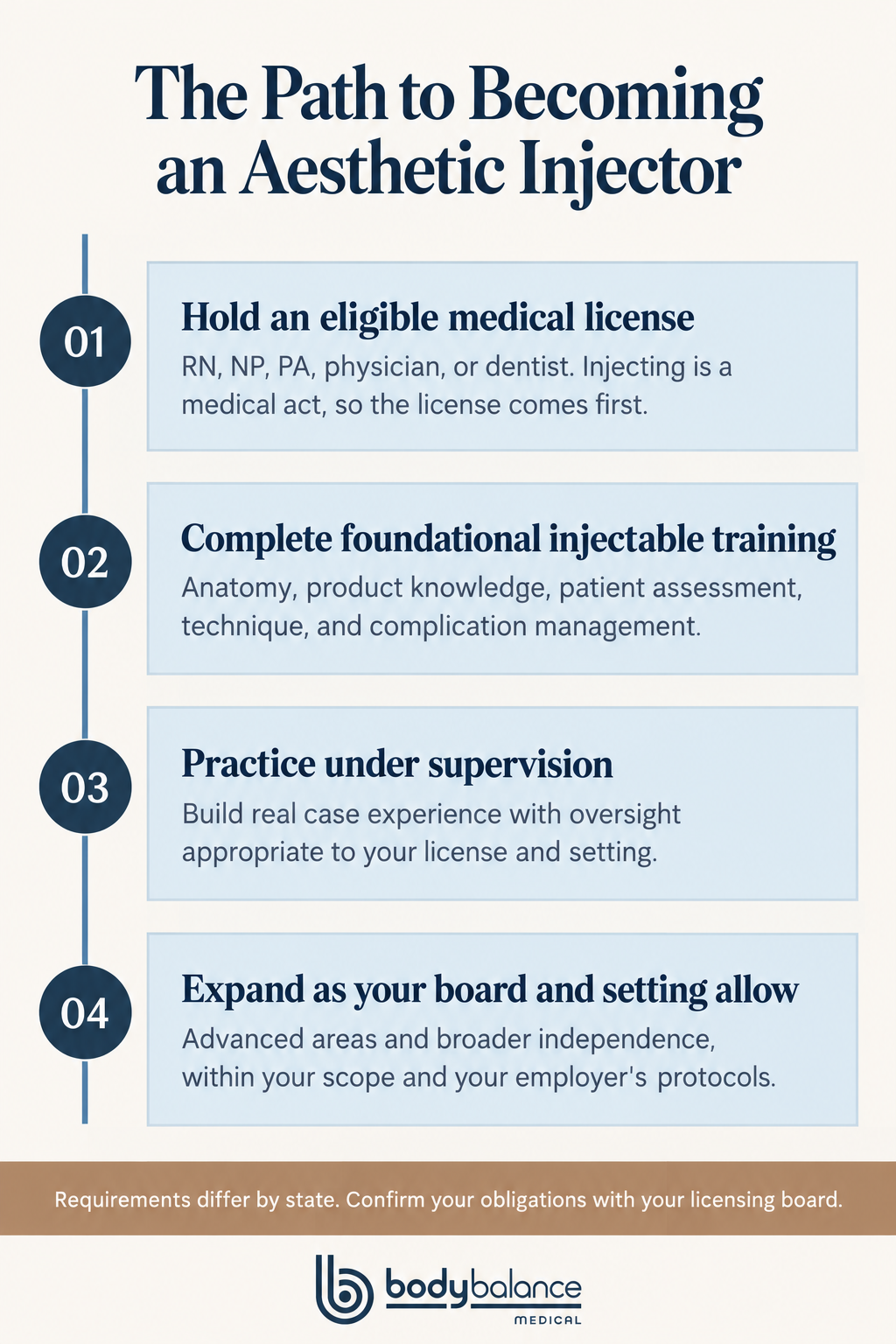
Obtain and maintain an appropriate medical license
Complete your core program, whether that is a BSN, a PA program, medical school, or dental school, pass the required national exam, and stay in good standing. Botox is a prescription-only medication, which is why a clinical license is the entry requirement rather than a formality.
Build a foundation in anatomy, pharmacology, and patient assessment
Understanding facial anatomy, neuromuscular physiology, adverse event recognition, and informed consent is essential before adding injectables to your practice. Clinicians who skip this step tend to discover the gap at the worst possible moment.
Complete foundational neurotoxin and filler training
Good foundational courses cover indications, contraindications, consultation flow, documentation, patient selection, and complication management. This is the stage where most clinicians enroll in a structured aesthetic training program.
Gain supervised, hands-on experience
This is where the gap between theory and safe practice closes. Working under supervision with real patients is what turns classroom knowledge into clinical judgment. Some programs include model patients as part of the curriculum; others expect you to arrange a separate clinical preceptorship.
Transition into practice within your scope
Look for positions in dermatology, plastic surgery, or a well-supervised medical aesthetics practice. Follow your medical director's written protocols. Start conservatively while you build experience in patient selection and treatment planning.
Commit to continuing education
Techniques, products, and complication management protocols change. Workshops, cadaver labs, conferences, and structured peer review are how experienced injectors stay current rather than coasting on a certificate earned years earlier.
What "certification" in aesthetic medicine actually means
In aesthetic medicine, "Botox certification" is a marketing phrase for course completion. It is not a legal credential, and it does not replace licensure, board certification in a specialty, or scope of practice rules.
Three separate things get conflated, usually on purpose:
- State licensure (RN, NP, PA, MD, DO, DDS, DMD) is what makes injecting lawful at all. Without it, nothing else matters.
- Board certification in a specialty such as dermatology or plastic surgery signals deeper expertise and is a long-term professional goal, not an entry requirement for aesthetics.
- Course certificates document that a clinician attended specific training. They are useful. They do not expand anyone's legal scope by one inch.
No weekend course, online class, or three-day intensive confers the right to inject on someone without the correct license. Any provider implying otherwise is telling you something important about itself. When you are evaluating a credential, check which body issues it, whether your own discipline recognizes it, and whether your malpractice carrier considers it meaningful.
None of this makes formal training less valuable. It makes training what it should be, which is education inside your existing professional scope rather than a shortcut around it.
Types of Botox training, and how to choose
Injectable training comes in several formats. The right one depends on your baseline experience, how you learn, and whether you have access to a supervising practice.
Didactic and online courses
Roughly $200 to $1,500. These cover theory, facial anatomy, pharmacology, and complication recognition through video and reading, and some include ongoing mentor access. They build real foundational knowledge, and they cannot substitute for supervised practice on live patients.
Weekend and short in-person workshops
Roughly $1,000 to $2,500, typically running one to two days. These mix lecture with limited demonstration. They are usually a first exposure rather than a complete path to independent practice, which is fine as long as the marketing says so.
Clinical preceptorships
Roughly $3,900 and up. A preceptorship places you inside a working medical aesthetics practice, where you see real patient flow, consultation structure, product preparation, and post-treatment follow-up. For clinicians who intend to inject regularly, this format does the most to close the distance between holding a certificate and being competent.
- What are the instructor's credentials, and how many years have they actually been injecting?
- Will you inject, or only observe? Under what conditions?
- How many learners share each live model?
- Does the program state plainly that it does not grant legal authority to inject?
- What happens after the course ends? Is there any clinical support?
Red flags in training providers
Demand for injectables has created a parallel market of training offers that range from thin to actively misleading. These are the signals worth walking away from.
- Courses marketed to estheticians or unlicensed individuals with the suggestion that a certificate will let them inject. That promise conflicts with how medical practice is regulated everywhere.
- Guaranteed model-patient injecting for every attendee, with no screening for license, scope, clinical readiness, or coverage. Responsible programs set conditions for who injects and when, and they tell you what those conditions are.
- Marketing built on income claims, fast certification, or opening a med spa right after a single course. That is a sales operation wearing a clinical education costume.
- No transparency about instructors. If a program will not clearly state who teaches, what their credentials are, and whether training happens inside an actual clinic, there is a reason.
Cross-check every claim against your own licensing board and your malpractice carrier. Where a board's position and a brochure disagree, the board's position is the one that governs you.
The Body Balance Medical 3-day injector preceptorship
Body Balance Medical's preceptorship exists for already-licensed clinicians who want structured, clinic-based training. It is not a certification course. It is clinical education inside a working practice.
Teresa Hernandez, MSN, FNP-BC leads the program. She is a Biote-certified provider with six years of experience as a cosmetic injector and four years training other injectors, and she teaches basic through advanced injection concepts at a local aesthetics school alongside running this preceptorship.
- Three days, held inside Body Balance Medical's active clinic at 7975 W Sahara Ave #101, Las Vegas
- Didactic review paired with observation and participation in real patient rooms, not a rented classroom
- Application-based enrollment with limited seats
- Tuition starts at $3,900
Hands-on model participation is available to qualified participants but is not guaranteed. Whether you inject depends on your licensure, your current scope of practice, clinical readiness, model availability, informed consent, and trainer approval. Participants who do not inject still observe complete treatments and take part in case discussion, treatment planning, and documentation review.
Completion documentation records your training hours and the topics covered. It does not replace state licensure, board requirements, employer protocols, or a medical director relationship where one is required.
Common questions
Do I need experience in dermatology or plastic surgery before learning Botox injections?
Helpful, but not required. Many nurse injectors and PAs come from ICU, emergency, primary care, or perioperative backgrounds. What matters most is a solid foundation in patient assessment, pharmacology, anatomy, and safe medication administration. Expect to start slowly under close supervision while you build experience.
How long does it realistically take to feel comfortable as a Botox injector?
An introductory course may run one to three days, but becoming comfortable usually takes months of regular supervised practice with real patients. Think in terms of a year or more of progressive experience, mentorship, and continuing education rather than expecting competence after a single weekend.
Can I open my own med spa right after completing a Botox course?
Opening a med spa involves far more than a training certificate. Regulatory compliance, business formation, malpractice coverage, staffing, and medical director requirements all differ by state. Focus first on becoming a safe, competent injector inside an established practice, then work with legal and compliance advisors in your state before considering ownership.
What should a new injector learn after neurotoxins?
Once you have a solid base, the usual next areas are hyaluronic acid dermal fillers, biostimulatory collagen treatments such as Sculptra and Radiesse, skin quality procedures such as microneedling, and combination treatment planning. Each requires its own training and supervised practice. Expanding too quickly without a firm foundation raises complication risk.
How does injector training fit into medical aesthetics more broadly?
Neurotoxins and dermal fillers are core components of medical aesthetics, alongside non-surgical treatments like body contouring, collagen stimulators, and advanced skin therapies. Many clinicians start with neurotoxins because demand is high and the protocols are well established, then expand as competence grows, always staying within their license and applicable state regulations.
Already licensed and ready for clinical training?
The Body Balance Medical preceptorship is three days inside a working Las Vegas aesthetics practice, built for RNs, NPs, PAs, physicians, and dentists entering injectables. Enrollment is application-based.
Apply for the Preceptorship